Marketing Silos: Why Disconnected Teams Slow Growth—and How to Fix The
By Mia PhamDigital Marketing & Growth Strategy Lead, Pixel Commerce Studio
September 18, 2026
Marketing Silos

The strategy is approved. The offer is ready. The campaign should already be moving.
Instead, copy is waiting for creative. Creative is waiting for feedback. Paid media needs final assets. The website still needs an update. Meanwhile, someone on your internal team is spending another afternoon asking everyone the same question:
Where are we on this?
This is one of the most common signs of marketing silos.
The problem is not necessarily a lack of talent, ideas, or marketing investment. In many cases, the real problem is that too many people, vendors, and channels are working independently instead of moving toward one shared campaign goal.
When marketing becomes disconnected, even a strong strategy can lose momentum before it reaches the customer.

What Are Marketing Silos?
Marketing silos happen when teams, agencies, departments, or vendors work separately with limited coordination.
Your SEO team may have one content plan. Your paid media agency may be running another message. Your designers may be working from an older brief. Your email team may be promoting a different offer, while your website has not yet been updated.
Individually, every team may be doing good work.
Collectively, however, the customer experience can feel fragmented.
That is why solving marketing silos is not simply a project-management problem. It is a brand consistency, campaign execution, and growth problem.
How Marketing Silos Slow Campaign Execution
Messaging Changes From Channel to Channel

A campaign usually starts with one positioning idea. But every additional handoff creates another opportunity for that message to change.
An ad emphasizes price. The website focuses on features. Email talks about convenience. Social media introduces another angle entirely.
None of these messages may be wrong, but together they can weaken the central reason a customer should choose the brand.
Strong cross-channel marketing does not require identical copy everywhere. It requires every channel to support the same core positioning.
Creative Consistency Begins to Break Down
Visual consistency can suffer for the same reason.
Different teams may use different photography styles, layouts, colors, typography, product presentations, or calls to action.
The result is a campaign that technically contains all the required assets but does not feel like one campaign.
For customers moving between search, social media, email, a website, and an online store, those small differences can make the experience feel less intentional.
Launch Timelines Get Longer
Every handoff creates another dependency.
Copy cannot be finalized until the offer is approved. Design cannot finish until copy is ready. Ads cannot launch without creative. The landing page cannot go live until development receives final assets.
A short delay at the beginning of the process can therefore affect every team after it.
This is why campaign speed depends not only on how quickly individual teams work, but also on how efficiently work moves between those teams.
Approvals Become Bottlenecks
Disconnected marketing also creates additional review cycles.
Instead of evaluating one campaign system, stakeholders may review ads, emails, web pages, social posts, and product assets separately.
Each review introduces new comments, revisions, and interpretation.
Over time, the organization can spend more effort coordinating marketing than actually improving it.
Your Internal Team Becomes the Integration Layer
One of the biggest hidden costs of marketing silos is internal management time.
When agencies and specialists do not communicate directly, someone inside the company has to connect them.
That person becomes responsible for transferring briefs, locating files, answering repeated questions, checking brand consistency, scheduling approvals, and resolving differences between vendors.
Instead of focusing on growth, customer insights, or strategy, the internal team becomes a project-management bridge between external partners.
Your Customer Experiences One Brand, Not Your Organization Chart
Customers do not know which vendor designed your ad or which agency built your landing page.
They do not care who manages your email automation, who optimized your Shopify store, or who created your social content.

They experience one brand.
A potential customer may first discover a product through an Instagram ad, search for the company on Google, visit the website, open an email three days later, compare a product, leave, and eventually return through a paid search ad.
That entire journey may involve several marketing platforms and several internal teams.
To the customer, however, it should feel like one connected experience.
The message, positioning, visual language, value proposition, and calls to action should reinforce one another throughout that journey.
Integrated Marketing Does Not Mean Posting the Same Thing Everywhere
Stay Ahead — Join the Pixel Insider List
Want more strategies on marketing, branding, technology, AI tools, or eCommerce growth?
Subscribe to get:
Integration is sometimes confused with duplication.
An integrated marketing strategy does not mean publishing identical content on Google Ads, LinkedIn, Instagram, email, and your website.
Each channel has a different role.
What should remain consistent is the core campaign idea.
For example, a search ad may communicate the value proposition in 30 characters. A landing page may explain it in detail. Social content may demonstrate the benefit visually. Email may address objections. A product page may provide the information needed to complete the purchase.
Different executions. Same strategy.
That is the difference between simply being present across multiple channels and operating a genuinely connected marketing system.
How to Build a More Connected Marketing Workflow

A better workflow does not necessarily require eliminating every specialist or vendor. It requires creating clearer ownership and shared campaign infrastructure.
- Start with one campaign brief. Define the audience, business objective, offer, positioning, primary message, proof points, conversion action, channels, timeline, and measurement plan before production begins.
- Create a message hierarchy. Establish the main value proposition first, followed by supporting benefits, proof points, objections, and channel-specific variations. This gives every team the same messaging foundation.
- Build a shared creative system. Campaign assets should follow common visual rules for photography, typography, layouts, product presentation, CTAs, and brand treatments rather than being designed independently for every channel.
- Develop channels in parallel when possible. Website, creative, advertising, email, social content, and eCommerce assets should inform one another during production instead of moving through a long sequential chain.
- Connect performance data back to the campaign. Search queries, ad performance, conversion data, email engagement, site behavior, and customer feedback should become inputs for the next round of creative and messaging.
A connected workflow reduces unnecessary translation between teams while making it easier to identify what needs improvement.
When Multiple Marketing Vendors Still Make Sense
Using several specialist partners is not automatically inefficient.
A company may legitimately need a specialized PR agency, technical SEO consultant, media buyer, packaging designer, developer, or production company.
The problem begins when no one owns the connection between those specialists.
For organizations using multiple partners, success depends on clear campaign ownership, shared documentation, consistent measurement, centralized assets, and an agreed approval process.
In other words, the goal is not necessarily fewer vendors.
The goal is fewer gaps between them.
Why Connected Marketing Matters for SEO and Paid Media
Search marketing makes campaign alignment especially important.
Organic content may introduce the problem. A paid search ad may capture commercial intent. The landing page needs to continue the same promise. The website then needs to guide users toward the appropriate next action.
If those experiences feel unrelated, marketing efficiency can suffer.
This is particularly important for paid search because the message used in the keyword, ad, and destination page should align closely with the user's intent. For SEO, the same principle means creating useful content around a clearly defined topic and connecting related pages through meaningful internal links.
A connected content architecture can therefore support both discovery and conversion rather than treating SEO, advertising, website content, and conversion optimization as unrelated activities.
From One Core Message to a Multi-Channel Campaign
Consider a brand preparing to launch a new product.
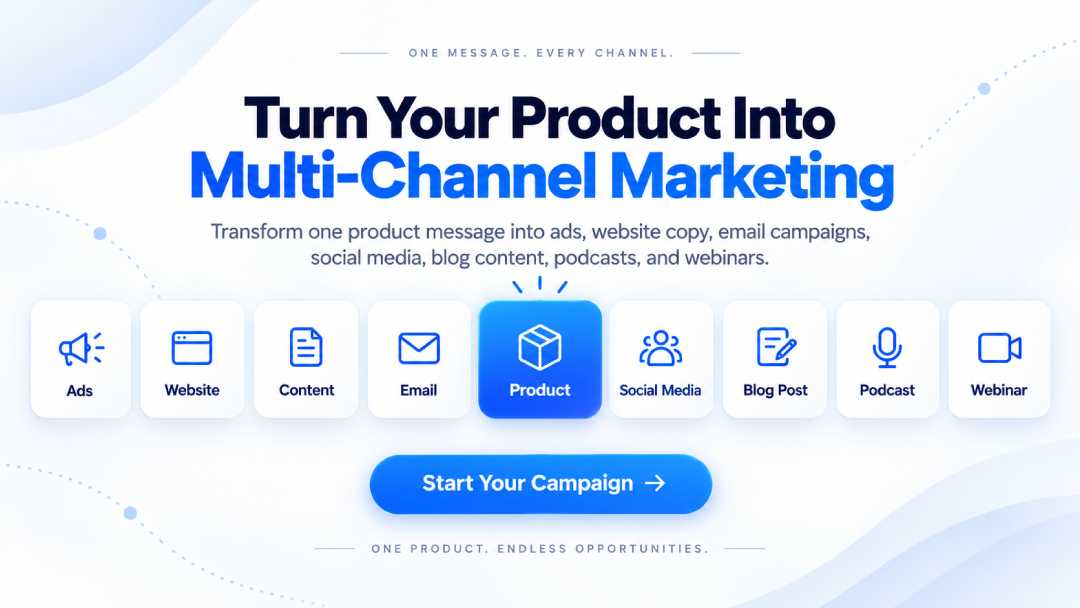
In a disconnected workflow, one agency develops the campaign concept, another creates social assets, a freelancer writes email copy, the ad agency adapts whatever assets it receives, and the website team updates the product page near the end.
Every participant has to reinterpret the original campaign.
A connected workflow starts differently.
The team first establishes the product positioning, customer problem, value proposition, key visual direction, offer, and conversion goal.
From that foundation, the campaign can expand into search ads, social ads, landing pages, email, product content, organic social, blog content, eCommerce assets, and supporting creative.
The deliverables are different, but they are all expressions of the same strategy.
That is how one message becomes a campaign instead of becoming a collection of unrelated assets.
How Pixel Commerce Studio Connects Strategy and Execution
Pixel Commerce Studio approaches marketing by bringing the moving pieces closer together.

That includes strategy, creative, digital marketing, eCommerce, and production—not because every company needs more services, but because these disciplines can work more efficiently when they are aligned around the same business outcome.
A campaign concept can inform creative.
Creative can inform paid media.
Paid media insights can improve landing pages.
Website behavior can guide conversion optimization.
Customer questions can inspire SEO and content.
eCommerce performance can influence the next campaign.
The objective is not simply to produce more marketing deliverables.
It is to reduce the gaps between strategy and execution so brands can move from idea to market with greater consistency.
Do You Need to Simplify Your Marketing?
If every campaign requires your internal team to coordinate several agencies, transfer the same information repeatedly, chase assets, reconcile messaging, and fix inconsistencies after launch, the structure itself may need attention.
Ask a few practical questions.
Does every marketing partner understand the same business objective?
Is there one approved campaign message?
Can every team access current brand and creative assets?
Are website, advertising, content, email, and eCommerce working from the same launch timeline?
Can performance insights move easily between channels?
If the answer is frequently no, the next improvement may not be another marketing tool or another vendor.
It may be a more connected operating model.
One Campaign Should Feel Like One Brand
Strong marketing is not simply a collection of ads, emails, web pages, graphics, social posts, and product listings.
It is a connected customer experience.
When strategy, creative, digital marketing, eCommerce, and execution move together, brands can spend less time chasing deliverables and more time improving the work that customers actually see.
One strategy. One brand. Multiple channels. Fewer gaps.
Simplify Your Marketing
Pixel Commerce Studio helps connect brand strategy, creative, digital marketing, eCommerce, and execution into a more coordinated approach to growth.
Ready to reduce the handoffs and move your next campaign forward?
FAQ: Marketing Silos
What are marketing silos?
Marketing silos occur when teams, departments, agencies, or vendors work independently without enough coordination. This can create inconsistent messaging, duplicated work, slower approvals, and fragmented customer experiences.
Why are marketing silos bad for growth?
Marketing silos can make campaigns slower and harder to manage because each team depends on information, approvals, and assets from other teams. They may also create inconsistencies between advertising, content, websites, email, social media, and eCommerce.
How can a company break down marketing silos?
Companies can reduce silos by using one campaign brief, defining shared messaging, centralizing creative assets, creating clear ownership, aligning timelines, and connecting performance data across channels.
What is the difference between integrated marketing and omnichannel marketing?
Integrated marketing focuses on keeping messaging and campaign execution coordinated across channels. Omnichannel marketing goes further by creating a connected customer experience as people move between those channels. The two approaches often work together.
Does a business need one agency for all marketing?
Not necessarily. Specialized partners can be valuable. The important factor is whether strategy, messaging, assets, timelines, measurement, and ownership are coordinated across those partners.


Like This Blog? Explore More from Pixel Commerce Studio
Dive into more insights across our most popular categories: