How B2B Social Media Marketing Generates Qualified Leads
By Lucas VuongDigital Marketing & Growth Strategy Lead, Pixel Commerce Studio
August 29, 2026
Learn how B2B social media marketing attracts qualified prospects, builds trust, supports lead generation, and creates a measurable pipeline through strategic content and social campaigns.

B2B Social Media Marketing for Lead Generation
B2B social media marketing can generate qualified leads when it is designed around buyer intent rather than vanity metrics. Instead of simply collecting followers, companies can use social channels to identify prospects, demonstrate expertise, and move interested buyers toward meaningful conversations.
This distinction is important. A large audience does not automatically produce revenue. However, a smaller audience made up of relevant decision-makers can create significant commercial value.
Therefore, successful B2B social media marketing focuses on the right people, the right message, and the right moment.
According to CMI's B2B research, 74% of marketers reported that content marketing helped generate demand or leads. Moreover, 49% said it helped generate sales or revenue.
What Makes a Social Media Lead Qualified?
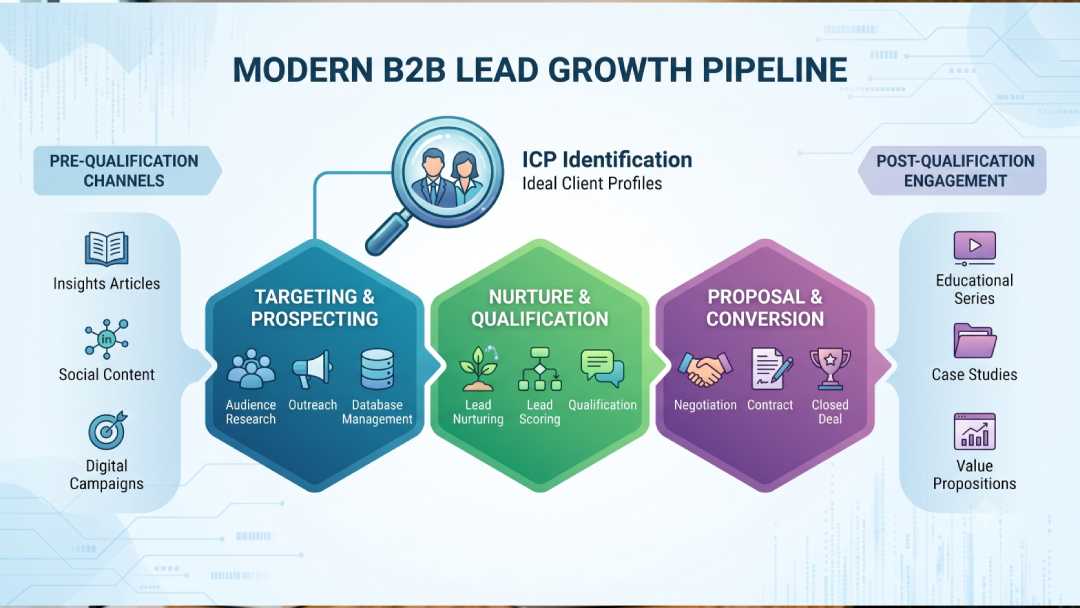
Not every social interaction represents a sales opportunity.
Someone who likes a post may simply find it interesting. Someone who downloads a guide, visits a service page, attends a webinar, and requests a consultation shows stronger buying intent.
Therefore, define lead quality before launching campaigns.
A qualified B2B social lead may:
- Match your target industry
- Have an appropriate company size
- Hold a relevant decision-making role
- Engage with high-intent content
- Visit commercial pages
- Download a valuable resource
- Request pricing
- Book a consultation
- Ask a product-related question
Furthermore, sales and marketing should agree on what qualifies as a marketing-qualified lead and sales-qualified lead.
Build a Lead Generation Funnel
An effective social funnel normally contains several stages.
Stage 1: Awareness
At the beginning, prospects may not know your company.
Therefore, publish educational content.
Examples include:
- Industry trends
- Statistics
- Research
- Common challenges
- Expert insights
- How-to content
The goal is simple: earn attention.
Stage 2: Engagement
Next, encourage prospects to interact.
Use:
- Polls
- Questions
- Comment discussions
- Short videos
- Carousels
- Industry debates
Moreover, respond to comments.
Social media should be social.
Stage 3: Consideration
Once prospects recognize your company, provide deeper resources.
Examples include:
- Case studies
- White papers
- Webinars
- Buying guides
- ROI calculators
- Comparison guides
These assets allow prospects to evaluate your expertise.
Stage 4: Conversion
Finally, create clear calls to action.
For example:
“Request a strategy consultation.”
“Get the B2B marketing audit.”
“Book a 30-minute discovery call.”
“Download the full benchmark report.”
Most importantly, make the next step obvious.
Create High-Intent Content
Many companies make the mistake of publishing only awareness content.
However, lead generation requires content that addresses commercial questions.
For example, instead of only publishing “What Is B2B Marketing?” create content such as:
- “How Much Does B2B Digital Marketing Cost?”
- “B2B SEO vs. Paid Search”
- “How to Choose a B2B Marketing Agency”
- “B2B Social Media Marketing Services”
- “LinkedIn Lead Generation Strategies”
These topics naturally attract people further along the buying journey.
Furthermore, comparison content can capture prospects who are actively evaluating options.
Use LinkedIn Strategically
Stay Ahead — Join the Pixel Insider List
Want more strategies on marketing, branding, technology, AI tools, or eCommerce growth?
Subscribe to get:

LinkedIn is particularly important for B2B marketing.
CMI's research found that 85% of B2B marketers consider LinkedIn the social platform delivering the best value. In addition, 68% reported increasing their use of LinkedIn during the previous 12 months.
Therefore, LinkedIn should often be a central part of a B2B lead-generation strategy.
However, do not turn every post into a sales pitch.
Instead, use a content ratio such as:
- 50% educational
- 20% industry insight
- 15% proof and case studies
- 10% engagement
- 5% direct promotion
The exact percentages can vary. Nevertheless, the principle remains useful: provide value before asking for a sale.
Use Employee Personal Brands

A company page is useful. Yet, personal profiles can create additional reach and credibility.
For example, a CEO can discuss business trends. A marketing director can explain campaign lessons. A technical expert can demonstrate how a product solves a specific problem.
Moreover, prospects often respond more naturally to people than corporate messaging.
LinkedIn reports that 77% of surveyed B2B marketing leaders say audiences rely on their networks when vetting brands.
Therefore, employee advocacy can support both awareness and lead generation.
Create Lead Magnets
A lead magnet should solve a specific problem.
Good examples include:
- B2B SEO Audit Checklist
- LinkedIn Lead Generation Guide
- B2B Marketing Budget Calculator
- Social Media Content Calendar
- Digital Marketing ROI Template
- B2B Website Conversion Checklist
Furthermore, the landing page should match the promise made in the social post.
If the post promises a 25-point SEO checklist, the landing page should immediately explain how to receive that checklist.
Retarget Engaged Prospects
Some prospects will not convert on the first visit.
Therefore, retargeting can help bring them back.
For example, someone who visits a service page can later see a case study advertisement. Someone who downloads an ebook can receive another relevant offer.
However, avoid excessive repetition.
Instead, change the message according to buyer intent.
Awareness visitor → educational content.
Engaged visitor → case study.
High-intent visitor → consultation.
This approach creates a more relevant customer journey.
Connect Social Leads to CRM Data
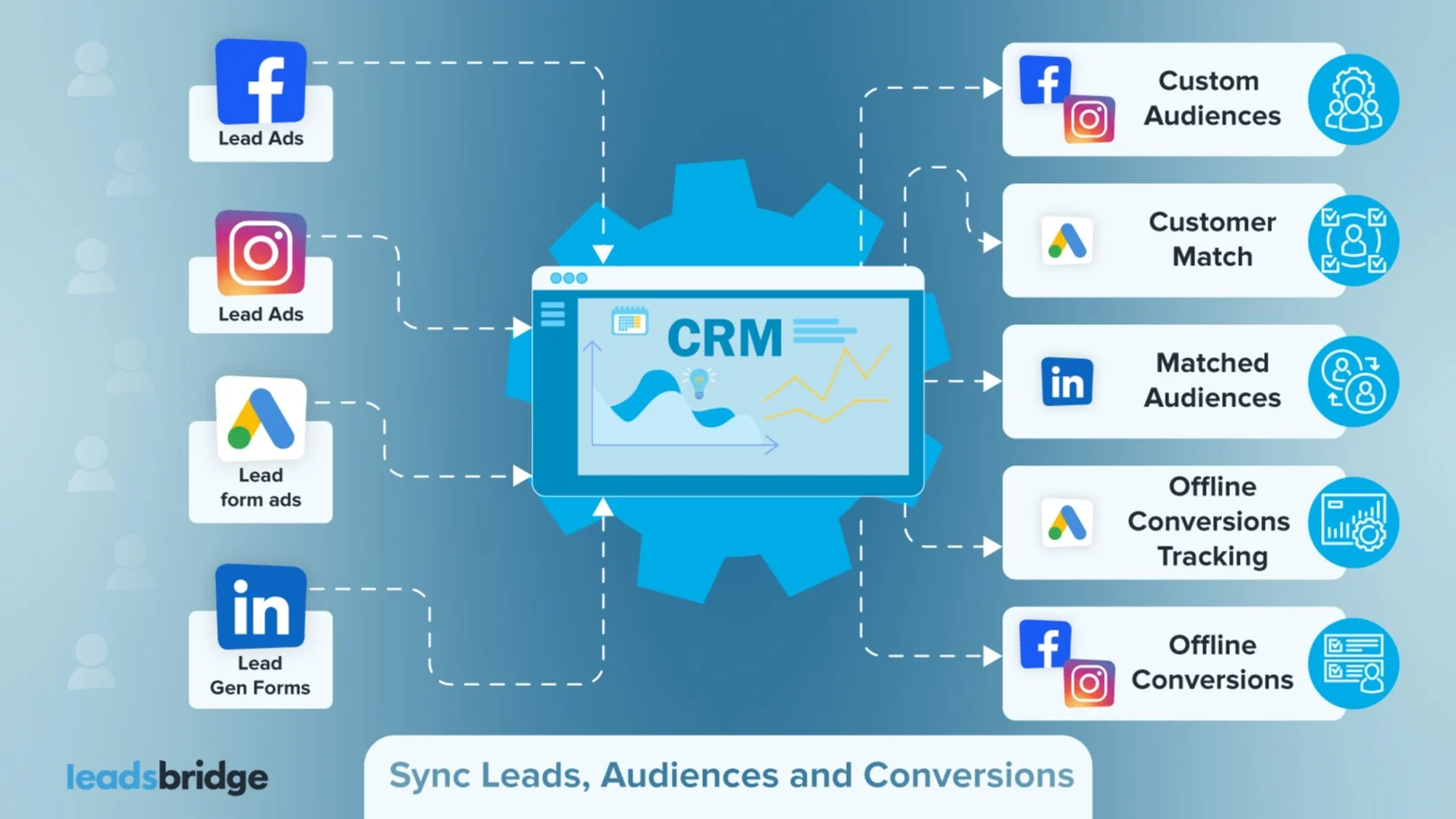
Social media becomes more valuable when marketing teams can see what happens after the click.
Track:
- Source
- Campaign
- Landing page
- Lead status
- Industry
- Company size
- Sales stage
- Opportunity value
- Closed revenue
Furthermore, use consistent UTM parameters.
For example:
- utm_source=linkedin
- utm_medium=social
- utm_campaign=b2b_lead_generation
This allows analytics platforms to identify campaign performance more accurately.
Use AI Carefully

AI can accelerate content production. However, it should not replace human expertise.
Google's guidance emphasizes original, helpful, people-first content for both traditional and AI-powered search experiences. Google also states that there are no special AI files or additional AI-specific SEO requirements needed to appear in AI Overviews or AI Mode.
Therefore, use AI to support research, ideation, summarization, visualization, and workflow automation.
Then add original experience, expert commentary, examples, data, and editorial review.
Measure Lead Quality, Not Just Volume
Imagine Campaign A generates 100 leads and Campaign B generates 30 leads.
At first, Campaign A appears better.
However, if only two Campaign A leads become opportunities while 15 Campaign B leads become opportunities, Campaign B is clearly more valuable.
Therefore, track:
| Metric | Purpose |
|---|---|
| Leads | Measures acquisition |
| MQLs | Measures marketing-qualified demand |
| SQLs | Measures sales readiness |
| Opportunities | Measures pipeline |
| Conversion rate | Measures efficiency |
| Cost per lead | Measures acquisition cost |
| Cost per opportunity | Measures lead quality |
| Revenue | Measures commercial impact |
Most importantly, optimize for revenue rather than reach alone.
Final Takeaway
B2B social media marketing can become a powerful lead-generation engine when every stage has a purpose.
First, attract the right audience. Next, educate them. Then, demonstrate expertise. After that, provide proof. Finally, make conversion easy.
Furthermore, connect social campaigns to landing pages, analytics, CRM systems, email marketing, and sales workflows.
Social media does not need to produce a sale immediately.
Instead, it needs to create enough trust and relevance for the right prospect to take the next step.


Like This Blog? Explore More from Pixel Commerce Studio
Dive into more insights across our most popular categories: