B2B Digital Marketing Agency: How to Choose the Right Fit
By Mia PhamDigital Marketing & Growth Strategy Lead, Pixel Commerce Studio
August 26, 2026
Evaluating a b2b digital marketing agency? Compare services, real cost drivers, in-house trade-offs, and the questions to ask before you sign a contract.

A b2b digital marketing agency usually gets hired at a very specific moment. Pipeline has gone quiet for two quarters. Sales is complaining that the leads marketing sends over are not real buyers. And nobody internally has the bandwidth to diagnose why.
That moment is where most agency searches begin. It is also where most of them go wrong, because the search starts with panic rather than a definition of the problem.
B2B marketing does not behave like consumer marketing. Deals are larger. Buying committees have four, six, sometimes ten people in them. The cycle can run six months or longer, and nobody signs because of a clever ad. Instead, they sign because your company looked credible at every touchpoint along the way.
This guide covers what these agencies do, how they generate qualified leads, how their pricing is structured, how they compare with hiring in-house, and the specific questions worth asking before you sign anything. The goal is to help you evaluate agencies properly, whether or not you end up hiring one.
What Is a B2B Digital Marketing Agency?
A b2b digital marketing agency is an external partner that plans and runs marketing aimed at other businesses rather than consumers. It typically owns some mix of strategy, search visibility, content, paid media, conversion design, and reporting.
The distinction from B2C matters more than most vendors admit. In consumer marketing, a single person decides, often quickly, and often emotionally. In B2B, that decision gets distributed.
Consider a typical software purchase. The end user wants the product to be pleasant to use. The department head wants it to solve a workflow problem. Finance wants defensible pricing. IT wants it not to break anything. Legal wants the contract to be clean.
Each of those people searches for different things and worries about different risks. Therefore, effective B2B marketing has to answer several audiences at once without becoming vague for all of them.
Two other differences shape everything an agency does. First, the sales cycle is long, so most of your marketing is talking to people who will not buy for months. Second, the deal values are high, which means a small improvement in win rate is worth far more than a large improvement in traffic.
What Does a B2B Digital Marketing Agency Actually Do?
Most agency websites list twenty services. That list is less useful than understanding what each one is supposed to accomplish.
Finding demand that already exists
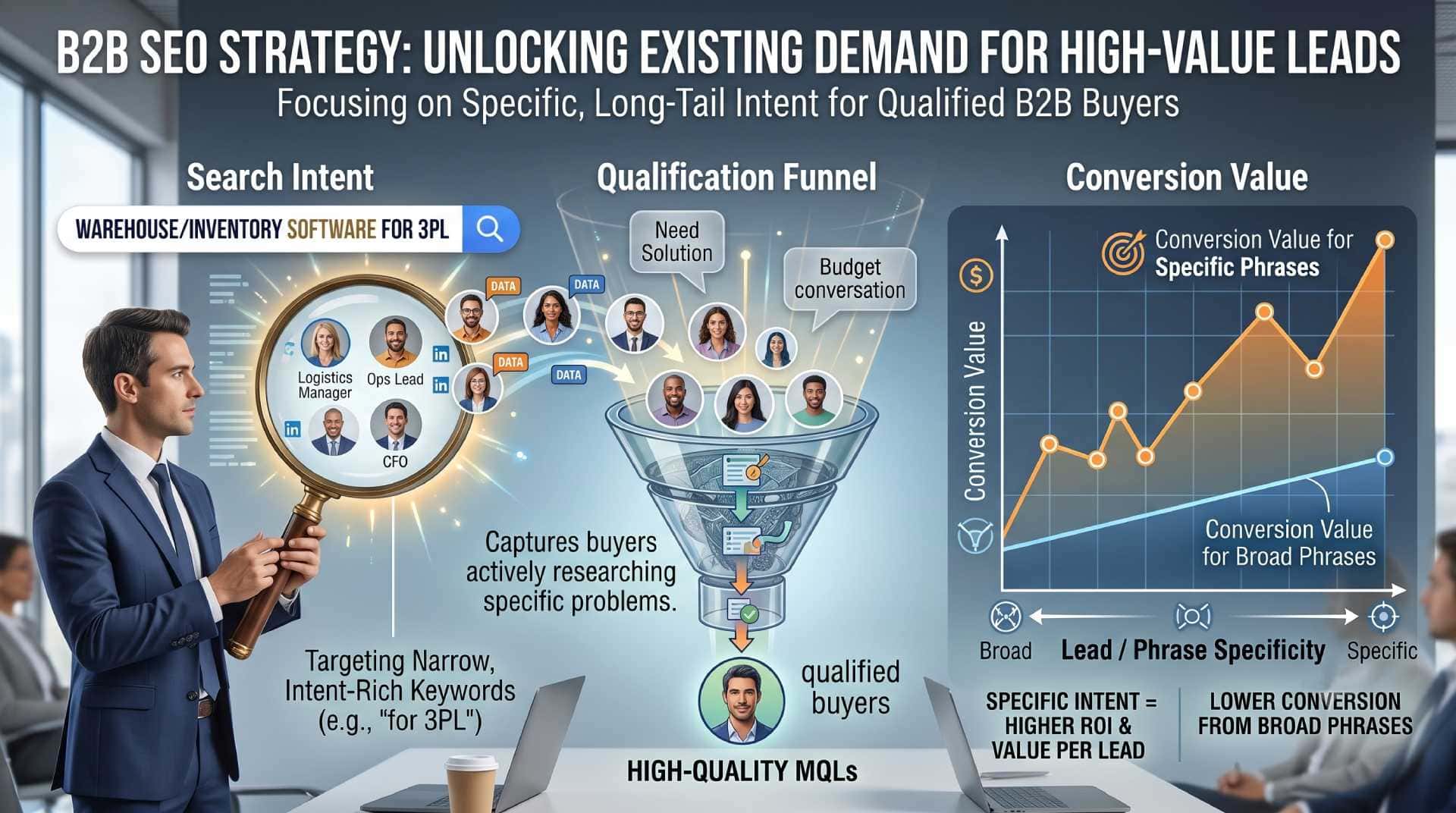
B2B SEO captures buyers who are actively researching. Someone searching "warehouse inventory software for 3PL" has a problem and a budget conversation already underway. Ranking for that phrase is worth more than ranking for something broad and popular.
Paid search does the same job faster and with a meter running. It is useful for testing which messages convert before you commit to a twelve-month content plan.
LinkedIn and paid social work differently. Here you are reaching people who are not searching yet but match your customer profile. Consequently, these campaigns should be judged on pipeline influence over time, not on immediate form fills.
Building the machinery that converts
Content marketing in B2B is not blog volume. It is comparison pages, implementation guides, and material that helps a champion inside the buying company sell your solution internally when you are not in the room.
Landing pages and conversion design decide whether the traffic you paid for turns into anything. A page that loads slowly, asks for eleven form fields, or buries the value proposition will waste every dollar spent driving people to it.
Email marketing and automation handle the long middle of the cycle. Because most B2B prospects are not ready at first contact, the follow-up sequence is often where the actual revenue is created.
Proving what happened
Analytics and attribution connect marketing activity to closed revenue. Without this, budget conversations become arguments about opinion. With it, you can defend or cut spend on evidence.
This is also the service most often promised and least often delivered well. Ask hard questions about it.
How a B2B Digital Marketing Agency Generates Leads
Lead generation is a chain, not a campaign. Every link filters the audience further, and a weak link makes everything upstream worthless.
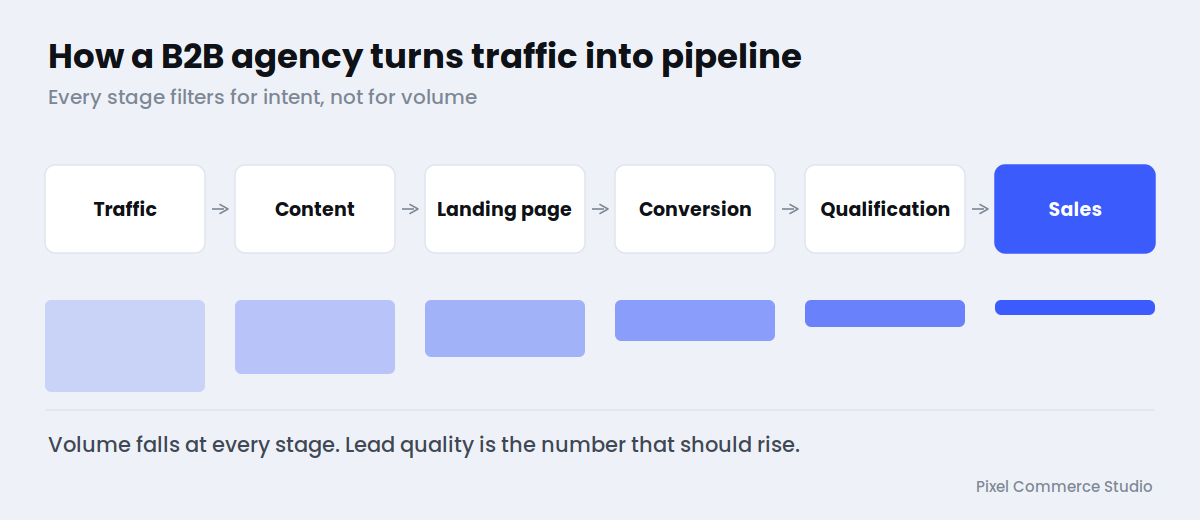
Traffic arrives from search, ads, or social. Content gives that visitor a reason to stay and a reason to trust you. A landing page makes a specific offer. Conversion turns an anonymous visitor into a known contact. Qualification separates the genuine buyers from the students, competitors, and browsers. Nurturing keeps the qualified ones warm until timing aligns. Sales closes.
Notice what happens to the numbers. Volume drops sharply at every stage, and that is correct. The metric that should be climbing is lead quality.
This is where the traffic obsession does real damage. An agency reporting a large jump in sessions has told you almost nothing. Ten thousand visitors who cannot buy your product are worth less than forty who can.
For example, a manufacturing company selling equipment with a six-figure price tag does not need broad awareness. It needs to be visible to roughly two hundred purchasing decisions per year in North America. Precision beats reach in that situation, every time.
B2B Digital Marketing Agency vs. In-House Marketing Team
Stay Ahead — Join the Pixel Insider List
Want more strategies on marketing, branding, technology, AI tools, or eCommerce growth?
Subscribe to get:
Agencies are not automatically the right answer. The honest comparison depends on which constraints actually bind your business.
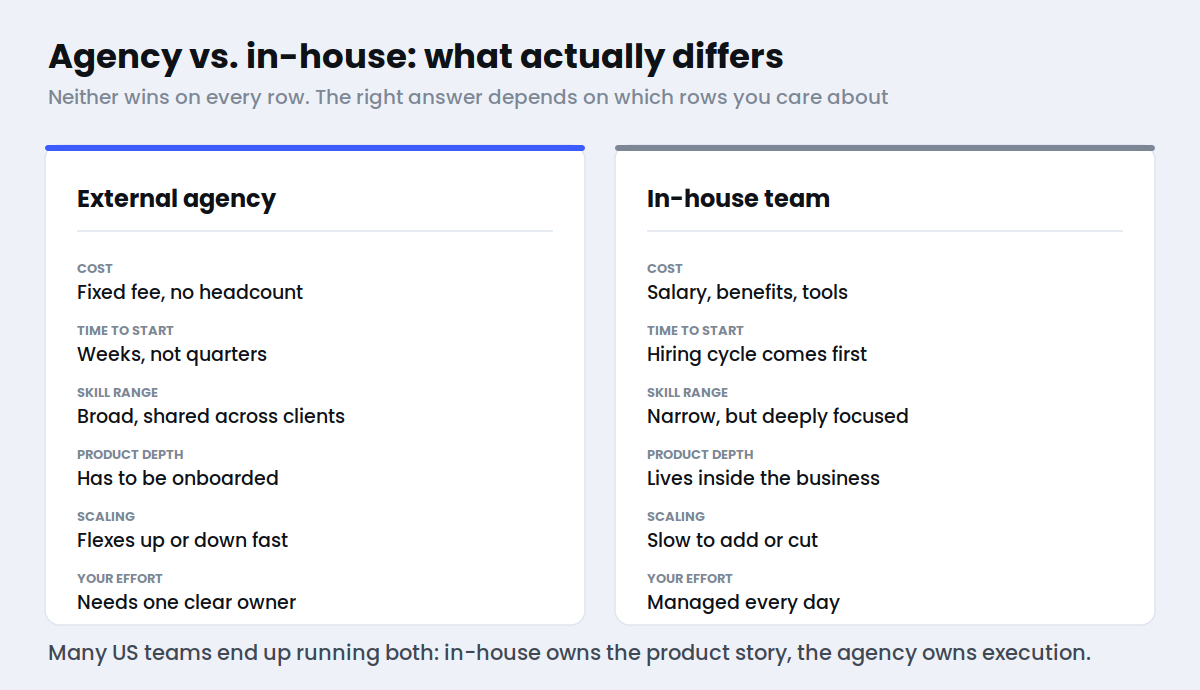
An agency tends to fit when you need several specialties at once but cannot justify a full-time hire for each. One person who is excellent at technical SEO, paid media, lifecycle email, and conversion design is rare and expensive. An agency spreads those specialists across clients, which is why the arrangement is affordable at all.
Agencies also start faster. A hiring cycle for a senior marketer in the US frequently runs three to five months from job posting to productive output. An agency can be working within weeks.
In-house tends to fit when your product is genuinely complex, your market is narrow, and the marketing advantage comes from deep domain knowledge. Nobody outside your company will ever understand your product the way your own team does. Furthermore, in-house knowledge compounds instead of walking out the door when a contract ends.
The hybrid is common and often correct. Many US companies keep a small internal team that owns positioning, product marketing, and the relationship with sales, then use an agency for execution capacity and specialist channels.
One caution worth stating plainly. An agency will not rescue marketing that has no internal owner. If nobody on your side can approve messaging, supply product knowledge, or make decisions, the engagement will stall regardless of how good the agency is.
What Drives the Cost of a B2B Digital Marketing Agency
Pricing in this industry is genuinely difficult to compare, because two proposals with the same monthly figure can describe completely different amounts of work.
Rather than quote market rates that go stale and vary enormously by region and scope, here is what actually moves the number:
- Number of channels. SEO alone costs less than SEO plus paid search plus paid social plus email.
- Content volume and depth. A technical whitepaper requiring interviews with your engineers costs many times what a short blog post costs.
- Ad spend management. Some agencies charge a percentage of media spend, which means your fee rises as you scale.
- Website and development work. Rebuilding landing pages or fixing site speed is project work layered on top of retainers.
- Creative production. Photography, video, 3D, and packaging design carry their own costs.
- Marketing automation. Building and maintaining lifecycle programs is ongoing labor, not a one-time setup.
- Strategy and reporting depth. Monthly dashboards cost less than quarterly strategic reviews with your leadership team.
Common structures include a monthly retainer, project-based fees, hourly consulting, a percentage of ad spend, or a blend. Retainers suit ongoing programs. Project fees suit defined deliverables like a site rebuild.
Two practical warnings. First, always confirm whether the quoted fee includes advertising budget or sits on top of it — this single ambiguity causes more disputes than any other. Second, treat guaranteed-results pricing with suspicion, because no agency controls your sales team, your product, or your competitors.
For a concrete sense of how scope maps to cost, service-level and bundled pricing is often published directly by agencies, including on Pixel Commerce Studio's own pricing pages.
What to Look For When You Evaluate Agencies
Beyond the obvious credentials, a few signals separate genuinely useful partners from confident ones.
B2B experience specifically. Consumer marketing skill does not transfer cleanly. Ask what they have run with long sales cycles and buying committees.
Willingness to disagree with you. An agency that accepts every assumption in your brief without pushing back is selling compliance, not expertise. Good partners will tell you when your target keyword is wrong.
A defined process. Ask how they get from kickoff to first results, and who does what. Vague answers here predict vague delivery later.
Honest measurement. They should be able to explain what they cannot attribute as clearly as what they can.
Named accountability. Find out who actually works on your account day to day. Senior people frequently sell the engagement and then disappear from it.
Capacity that matches your scope. If you need SEO, ads, a site rebuild, and product photography, a specialist SEO shop will subcontract most of that. Sometimes that is fine. Sometimes it means four vendors, four timelines, and inconsistent creative.
That last point is where integrated studios have a structural advantage. Pixel Commerce Studio, for instance, combines digital marketing with web and app development, branding, 2D and 3D design, video, and e-commerce production under one roof, which removes the coordination overhead of managing separate vendors for strategy and execution.
Questions to Ask Before You Sign
Take these into the second call, after the pitch is over.
- Which industries and deal sizes have you worked with that resemble ours?
- How do you define a qualified lead, and who agrees to that definition?
- Which KPIs will you report, and which will you be held to?
- What is realistically achievable in ninety days, and what takes longer?
- Who works on this account daily, and what is their experience level?
- What exactly is included in the fee, and what triggers additional charges?
- Is advertising budget included or separate?
- How do you handle a channel that underperforms for three months?
- Who owns the accounts, content, and data if we part ways?
- What do you need from our team, and how much of our time will it take?
- What is the notice period, and what happens at termination?
- Can you show work where results were mixed, and explain what you changed?
Question twelve is the most revealing. Every agency has campaigns that underperformed. The ones worth hiring will tell you about them.
How to Measure B2B Digital Marketing Performance
Agree on metrics before the contract starts, not after the first disappointing report.
Metrics that matter: qualified leads, marketing-qualified and sales-qualified lead counts, conversion rate at each funnel stage, cost per qualified lead, customer acquisition cost, pipeline value influenced, win rate, and revenue contribution.
Metrics that mislead in isolation: impressions, raw sessions, follower counts, and total form submissions. These describe activity rather than outcomes. They are useful as diagnostics when something breaks, but they are not results.
Timing expectations matter too. Paid campaigns produce data within weeks. SEO and content typically need several months before meaningful movement, and longer in competitive categories. Any agency promising fast organic rankings in a mature market is either misunderstanding the work or misrepresenting it.
Finally, insist that reporting connects to revenue. If your CRM and analytics are not integrated, fixing that is often the highest-value project in the first quarter.
Why an Integrated Approach Reduces Wasted Spend
Disconnected marketing is expensive in ways that never show up on a single invoice.
Picture the common setup. An SEO vendor builds content around one set of messages. A paid media freelancer writes ads with different positioning. A web developer builds landing pages neither of them was consulted on. A designer produces brand assets that arrive after the campaign launched.
Every handoff loses information. Meanwhile, the buyer experiences all of it as one company and quietly concludes that the company is disorganized.
When strategy, content, advertising, web development, creative production, and conversion design sit together, the messaging stays consistent and assets get reused instead of rebuilt. As a result, the same budget produces more usable output.
This is not an argument that full-service is always better. A specialist agency with deep expertise in one channel can outperform a generalist on that channel. The right question is whether your bottleneck is depth in one area or coordination across several.
FAQ: B2B Digital Marketing Agencies
What does a b2b digital marketing agency do?
It plans and executes marketing aimed at business buyers, typically covering strategy, SEO, content, paid media, email automation, conversion design, and reporting. The core job is turning digital channels into qualified pipeline rather than traffic.
How does a B2B agency generate leads?
Through a chain: attract relevant traffic, offer content worth exchanging contact details for, convert on a focused landing page, qualify against your ideal customer profile, then nurture until the buyer is ready. Each stage filters for intent.
How much does a b2b digital marketing agency cost?
It varies widely based on channel count, content volume, ad spend, creative production, and whether website work is included. Ask specifically whether media budget is inside or outside the fee, since that single detail can change the total dramatically.
Is hiring a B2B agency worth it?
It depends on your constraint. If you need several specialties without the headcount to hire them, or you need to move faster than a hiring cycle allows, an agency usually pays for itself. If your advantage comes from deep product knowledge in a narrow market, in-house may serve you better.
What services should a B2B agency provide?
At minimum: strategy, B2B SEO, content, paid media, conversion optimization, and analytics. Beyond that, match services to your actual gaps rather than buying a full suite by default.
How long before B2B digital marketing produces results?
Paid channels generate data in weeks. Organic search and content usually take several months, sometimes longer in competitive categories. Treat any guarantee of rapid organic rankings as a warning sign.
How do I choose the right b2b digital marketing agency?
Define your problem first, then evaluate on relevant B2B experience, a clear process, honest measurement, named accountability, and scope that matches your needs. Ask about work that did not go well.


Like This Blog? Explore More from Pixel Commerce Studio
Dive into more insights across our most popular categories: